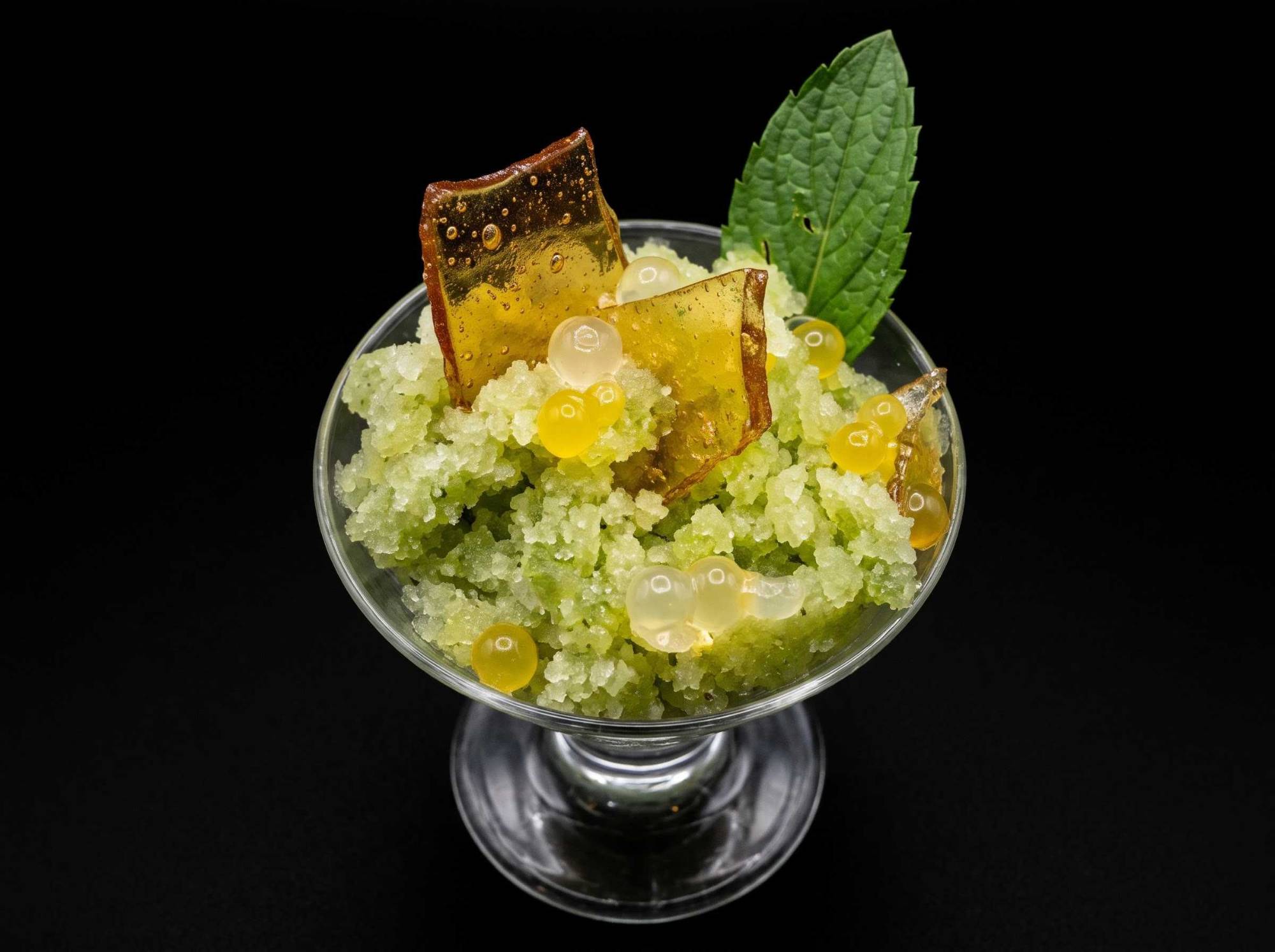
Cucumber, Lime & Spearmint Sorbet
Ingredients
Cucumbers vary in size and juice, so these amounts are estimates. Your strained juice may weigh more or less.
For the cucumber juice
- Approximately 3 medium-large cucumbers, enough to produce 460 g strained juice
For the sorbet
- 460 g freshly extracted cucumber juice
- 105 g granulated sugar
- 45 g light corn syrup
- 30 g water
- 25 g freshly squeezed lime juice
- Finely grated zest of ¼ lime
- 0.9 g fine salt
- A trace of food-grade spearmint oil, diluted appropriately for culinary use
Spearmint oil doesn't scale by the drop. How much to add depends on the strength of the culinary preparation you're using, so add it a little at a time and taste.
Method
- Wash and roughly chop the cucumbers. Retain the skin unless it tastes noticeably bitter.
- Blend until thoroughly liquefied. Pass through a fine-mesh sieve, pressing gently to extract the juice while leaving behind the fibrous pulp. Measure the extracted juice (about 460 g) and refrigerate it.
-
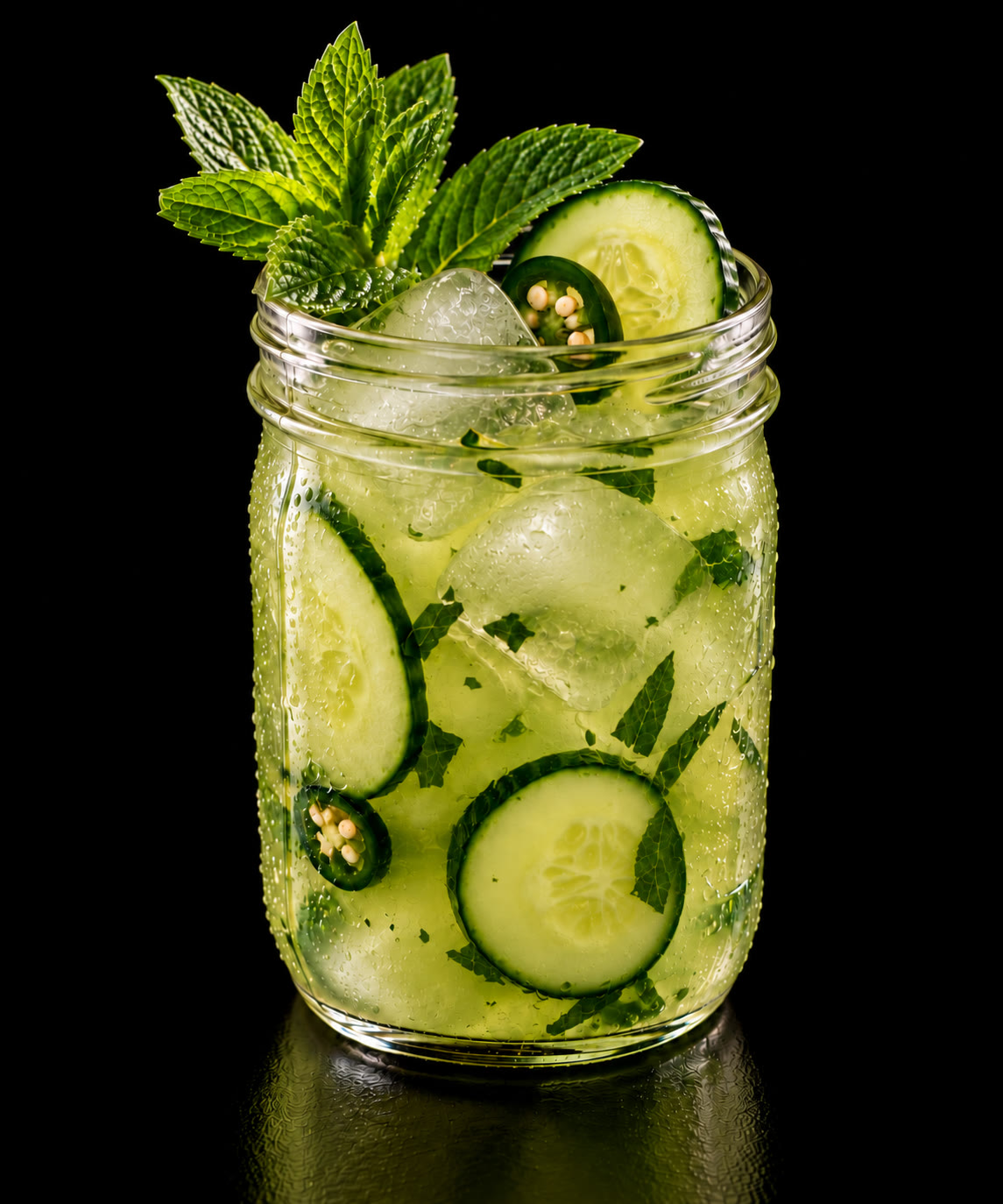
Keep the pulp
The strained cucumber pulp still contains moisture and flavor. Save it for our Cucumber, Mint & Jalapeño Cooler.
View the recipe - Combine the sugar (105 g), corn syrup (45 g), and water (30 g) in a small saucepan. Warm gently, stirring until the sugar dissolves. Remove from the heat and chill the syrup completely.
- Combine the cold cucumber juice, chilled syrup, lime juice (25 g), and salt (0.9 g). Stir thoroughly, cover, and refrigerate until cold, ideally 2–4°C.
- Add the lime zest and a very small amount of appropriately diluted food-grade spearmint oil. Mix thoroughly and taste. The mint should remain subtle, with cucumber as the dominant flavor.
- Freeze the mixture using your preferred method until it reaches a smooth, cohesive, soft-frozen consistency.
Ice cream maker
Chill the base thoroughly, then churn according to the manufacturer's instructions until uniformly soft-frozen. Both compressor and pre-frozen-bowl machines are suitable.
Ice and salt bag
Place a small quantity of the chilled base in a tightly sealed freezer bag. Put this inside a larger bag containing ice and salt, keeping the salt mixture outside the inner bag. Agitate continuously until the sorbet thickens and freezes.
This method is best suited to small batches. Its texture may be less consistent than machine-churned sorbet.
Freezer method
Pour the mixture into a shallow freezer-safe container. Freeze, stirring and breaking up the ice crystals approximately every 30 minutes until frozen.
For a finer texture, process the partially frozen mixture briefly in a food processor before the final freeze.
All three lead to the same next step: hardening in the freezer.
- Transfer the sorbet to a shallow airtight container and freeze for at least 4 hours, preferably overnight.
- Before serving, allow the sorbet to soften gradually in the refrigerator until it can be shaped without cracking. Form a quenelle or scoop onto a chilled plate and serve immediately.
More information
The chemistry of cucumber
Cucumber's distinctive aroma comes largely from volatile aldehydes, particularly (E,Z)-2,6-nonadienal, which contributes the characteristic fresh cucumber smell.
These aroma compounds are released when cucumber tissue is disrupted during cutting or blending. Prolonged exposure to heat, air, and aggressive processing can alter the volatile profile, so the cucumber is extracted cold and combined with syrup only after the syrup has cooled.
Cucumbers also contain phenolic compounds that can contribute to bitterness and astringency. Their concentrations vary with cultivar, growing conditions, and processing. However, pronounced cucumber bitterness is often associated with cucurbitacins, a separate class of compounds. Cucumbers that taste unusually bitter should be discarded.
Why two sugars?
Sucrose provides sweetness and contributes to freezing-point depression. Light corn syrup supplies additional dissolved carbohydrates, affecting the amount of unfrozen water and the finished texture.
Together, they help produce a sorbet that can be shaped after tempering without becoming excessively icy.
The precise effect depends on the corn syrup's composition, the total dissolved solids, and the freezing conditions.
Acidity and aroma
Lime juice introduces acidity, while lime zest supplies aromatic oils from the peel. Separating these ingredients allows acidity and citrus aroma to be adjusted independently.
Spearmint contributes a different aromatic profile from peppermint. Its characteristic compound, carvone, provides a sweeter herbal impression, whereas peppermint generally contains more menthol.
The spearmint is deliberately restrained to preserve the cucumber's delicate aroma.
| Ingredient | Characteristic compound | Impression |
|---|---|---|
| Cucumber | (E,Z)-2,6-nonadienal | Fresh cucumber |
| Lime peel | Limonene, with citral | Citrus |
| Spearmint | Carvone | Sweet, herbal |
| Peppermint, for comparison | Menthol | Cooling |
Freezing and serving
Sorbet texture depends on the size and distribution of ice crystals, the amount of unfrozen liquid, and the composition of the base.
Churning introduces movement during freezing, limiting the formation of large ice crystals. Once frozen, the sorbet should be stored in an airtight container at a stable temperature.
For a smooth quenelle, allow the sorbet to temper until it yields to a spoon without cracking but remains firm enough to hold its shape.