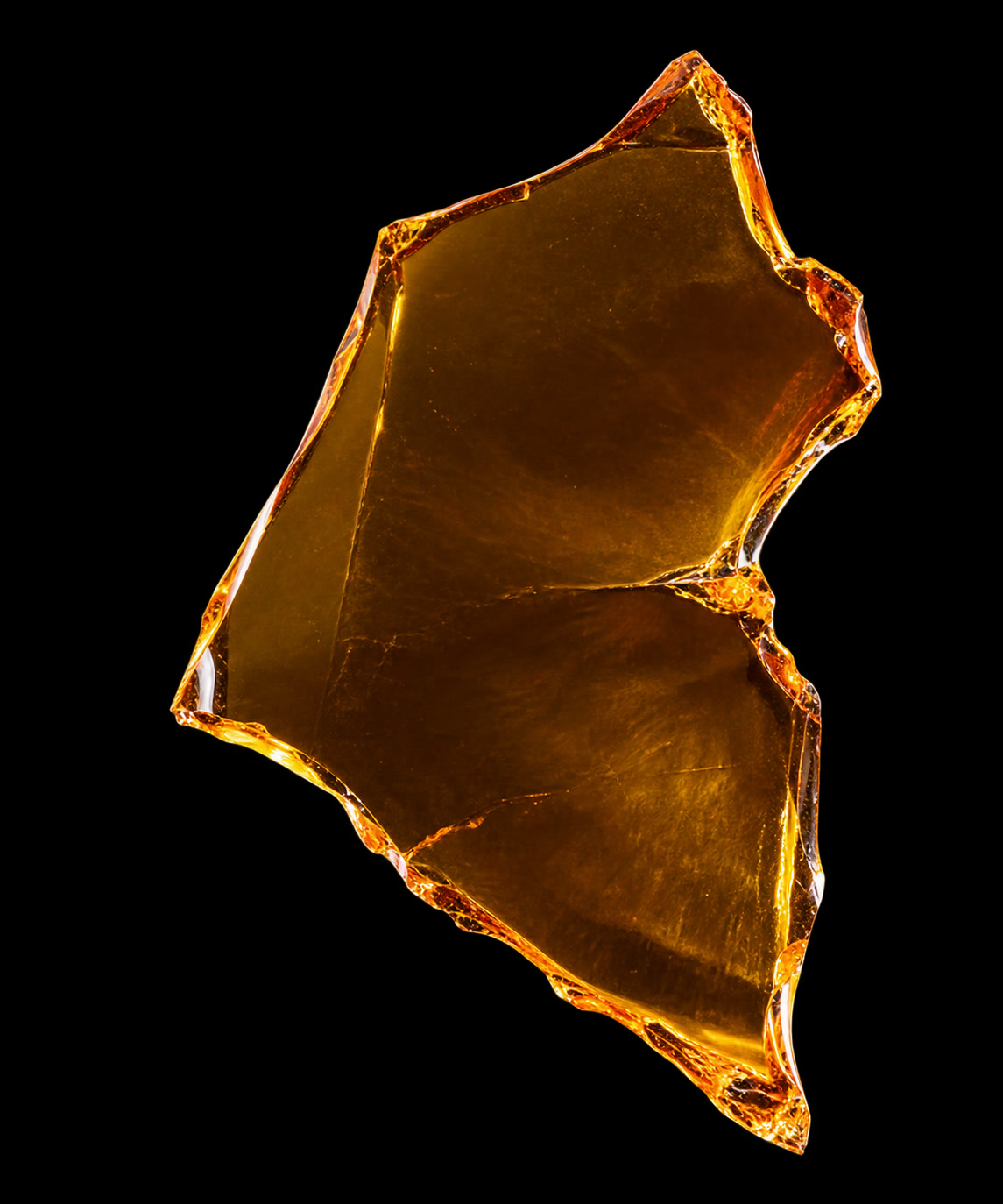
Amber Sugar Glass
Ingredients
- 150 g organic, minimally refined golden cane sugar
- 45 g water
Sugar selection: Choose a dry, granulated golden cane sugar with a light natural amber color, rather than dark brown sugar, muscovado, or powdered sugar. Organic golden cane sugar is preferred, but any comparable lightly refined cane sugar will work.
Method
- Line a flat, heat-resistant baking tray with a silicone baking mat. Prepare a second flat surface for cooling.
- Combine the sugar and water in a small, heavy-bottomed saucepan. Stir gently until the sugar is evenly moistened.
- Place over medium heat. Stir only until the sugar has dissolved, then stop stirring.
- Allow the syrup to boil undisturbed. If sugar crystals form on the sides of the saucepan, carefully wash them down with a pastry brush dipped in water.
- Continue cooking until the syrup develops a clear golden-amber color. For a brittle finish, the syrup should reach approximately 150–155°C (302–311°F), the hard-crack stage.
Caramelization guide
- Temperature
- Below 149°C / 300°F
- Appearance
- Clear and colorless, or faintly tinted by golden cane sugar
- Flavor
- Sweet, with no caramel notes yet
- For sugar glass
- Not yet. It sets sticky or chewy rather than brittle
- Temperature
- 149–155°C / 300–311°F
- Appearance
- Clear to pale gold; golden cane sugar shows a light amber tint
- Flavor
- Clean sweetness, with a faint molasses note from the cane sugar
- For sugar glass
- The target. It sets hard, brittle and transparent
- Temperature
- About 160–170°C / 320–338°F
- Appearance
- Golden amber, still clear
- Flavor
- Light caramel
- For sugar glass
- Works, with a deeper color. Take the pan off the heat promptly
- Temperature
- About 170–180°C / 338–356°F
- Appearance
- Deep amber, less transparent
- Flavor
- Pronounced caramel, with the first hints of bitterness
- For sugar glass
- Usable for a darker look, but less clear and more bitter
- Temperature
- Above 180°C / 356°F
- Appearance
- Dark brown, close to opaque
- Flavor
- Bitter and burnt
- For sugar glass
- Too far
Temperature and color are related but not interchangeable. The thermometer shows how much water has cooked off; the color shows how far caramelization has gone, which also depends on time and on the sugar. Golden cane sugar starts out tinted, so it can look amber at a lower temperature than white sugar would.
- Remove the saucepan from the heat immediately when the desired color is reached. The syrup will continue darkening briefly from residual heat.
- Allow the largest bubbles to subside for a few seconds without letting the caramel begin to harden.
- Carefully pour the hot caramel onto the prepared silicone mat. Tilt the tray gently to spread it into a thin, even sheet, approximately 2–3 mm thick. Avoid touching or spreading the caramel with your hands.
-
Safety
Molten sugar can cause severe burns and adheres to skin. Use heat-resistant equipment, keep the work area clear, and never touch the caramel until it has cooled completely. Hardened shards can also have sharp edges. Handle carefully and avoid serving pieces with dangerously pointed projections.
- Leave undisturbed at room temperature until completely cool and rigid, approximately 20–30 minutes.
- Peel the hardened sugar sheet away from the silicone mat.
- Break it into irregular, angular shards. Aim for relatively flat pieces with clean, sharp edges and smooth, translucent surfaces.
- Store immediately in an airtight container in a cool, dry environment until ready to use.
-
Keep it dry.
Sugar glass absorbs moisture from the air. Store it airtight at room temperature and add it to desserts immediately before serving.
Where to Use It
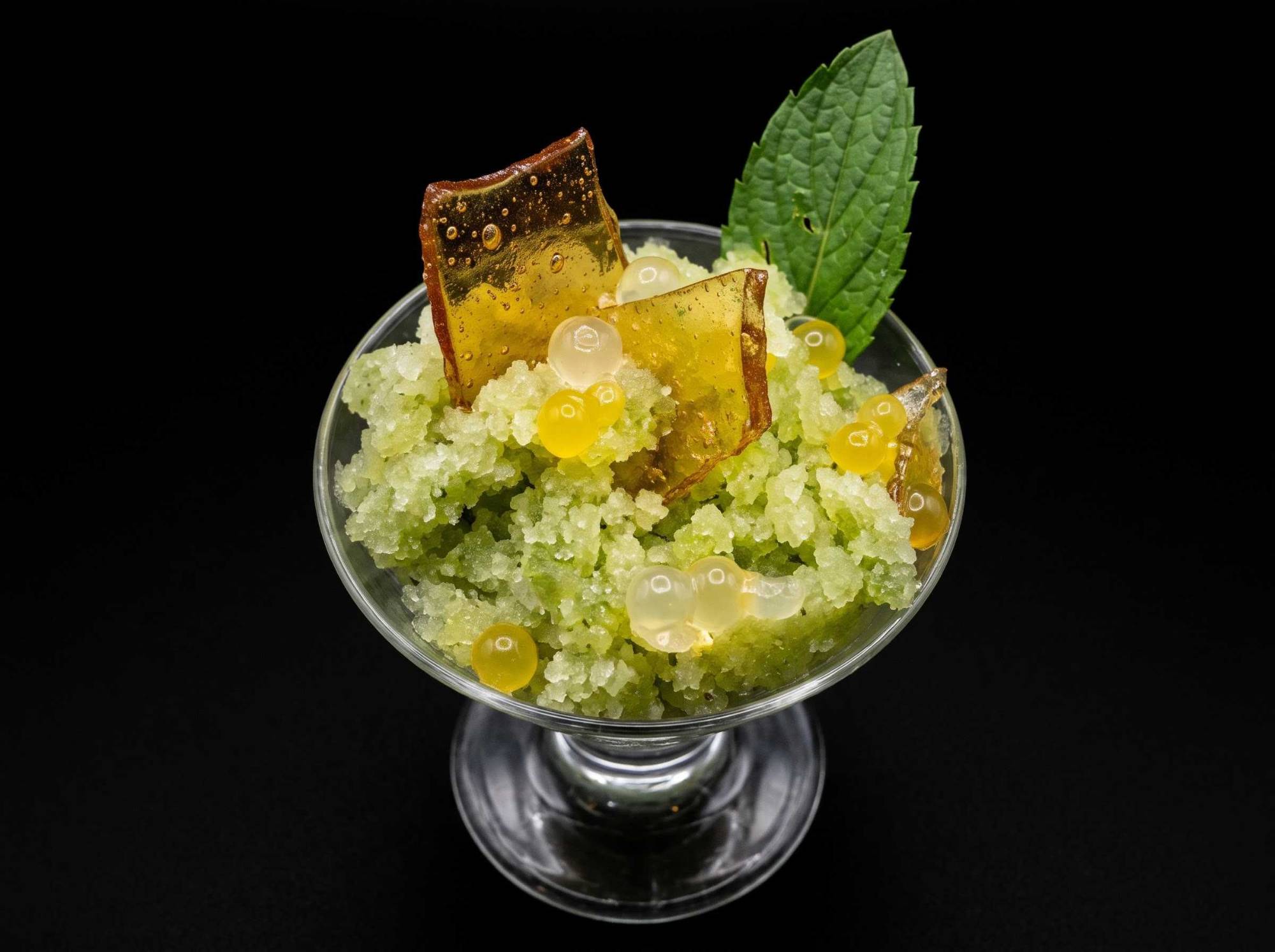
A little contrast.
These delicate amber shards add crisp texture and warm caramel notes to our refreshing Cucumber, Lime & Spearmint Sorbet.
View the sorbet →More information
The science of sugar glass
Sugar glass is an amorphous solid: its molecules lack the repeating, ordered structure found in crystalline sugar.
When sugar dissolves in water and the solution is heated, the water gradually evaporates, increasing the concentration of dissolved sugar.
At sufficiently high temperatures, the concentrated syrup becomes capable of hardening into a rigid, glass-like material when cooled.
Rapid cooling and the absence of crystal-forming disturbances help prevent sucrose molecules from organizing into large crystals.
The result is a transparent, brittle sheet that resembles ordinary glass.
Why does it turn amber?
The amber color develops through caramelization.
As sugar is heated, it undergoes a complex series of chemical reactions, including dehydration, fragmentation, and the formation of new compounds responsible for caramel's characteristic color and aroma.
The precise chemistry depends on temperature, time, moisture, and sugar composition.
Light caramelization produces golden tones and relatively mild flavors. Further cooking produces deeper amber colors and more pronounced caramel notes.
Eventually, excessive heating introduces unpleasant bitterness and can cause burning.
For decorative sugar glass, the goal is to develop enough color to create a warm amber appearance without producing an excessively dark or bitter caramel.
Why use minimally refined cane sugar?
Minimally refined golden cane sugar retains small amounts of naturally occurring sugarcane constituents that are largely removed during extensive refining.
Depending on the product, these may include trace minerals and residual molasses compounds that contribute color and flavor.
However, less-refined sugar does not automatically produce clearer or better sugar glass.
Residual impurities can affect crystallization, color, and transparency.
For this recipe, choose a relatively light golden cane sugar with uniform, dry granules.
Avoid dark, moist sugars such as muscovado, which introduce stronger molasses flavors and make achieving a clear, consistent amber sheet more difficult.
Organic certification is optional from a technical standpoint. The sugar's composition and degree of refinement matter more to the finished glass.
Why is sugar glass sensitive to humidity?
Sugar glass is hygroscopic, meaning it can absorb moisture from the surrounding environment.
As moisture enters the material, it lowers the glass transition temperature and increases molecular mobility.
The glass gradually loses its rigidity, becoming sticky, flexible, or cloudy.
This is why sugar decorations should be stored in airtight containers and added to desserts shortly before serving.
Refrigeration is generally undesirable because condensation can accelerate moisture absorption.